My fifth stained glass project was supposed to be another step forward, but choosing the wrong glass turned my raven pattern into one of my biggest challenges yet. From shattered pieces and frustrating cuts to learning when to walk away and come back, this is the story of the stained glass project I almost scrapped.
My Confidence Was Growing
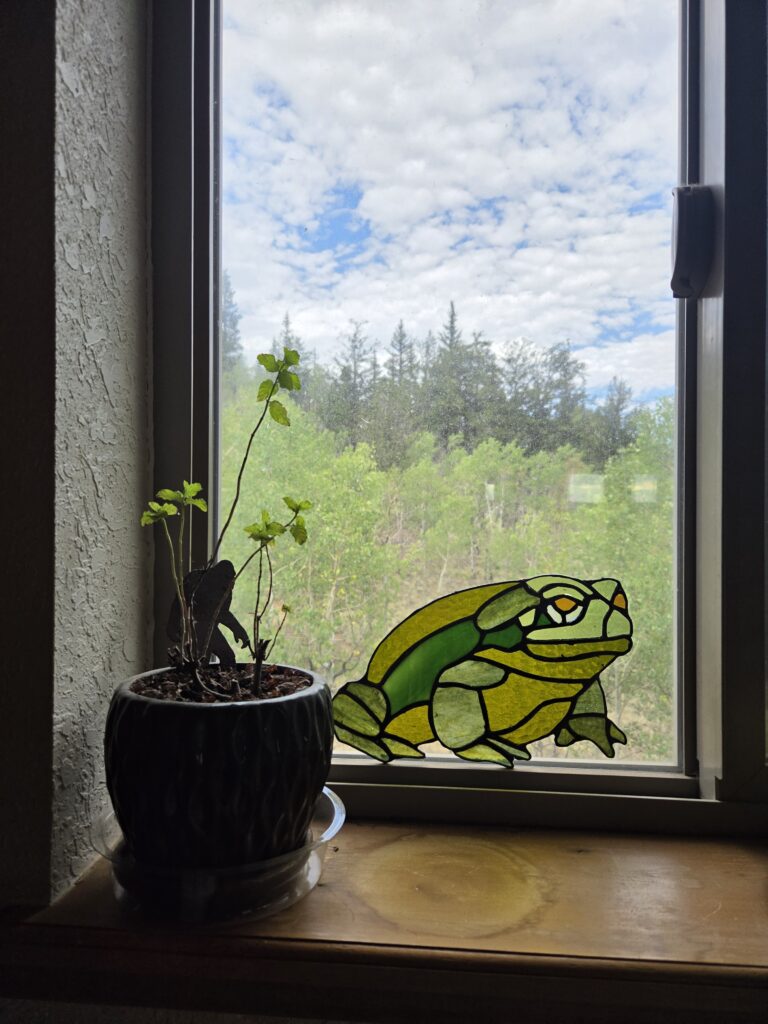
I had just finished my fourth stained glass piece, a toad, and I was feeling pretty confident in my progress. My soldering still needed a lot of work, and my beaded edges looked… questionable at best, but my glass cutting had improved dramatically. I hadn’t needed to recut a single piece, which felt like a huge milestone as a beginner. I figured my next stained glass project would be more of the same.
Oh, how wrong I was.
The Glass That Humbled Me
I had purchased a raven stained glass pattern from Etsy and couldn’t wait to get started. I had also picked out the most beautiful dark blue glass that shimmered ever so slightly. Unless the light hit it just right, it looked completely black, making it the perfect color for a raven.
I bought the sheet purely because I loved the color. It was sitting in the stained glass section, so naturally I assumed it would work just like every other sheet of glass I had used.
Rookie mistake.
I didn’t realize until I laid it on my light board that the glass was completely opaque. There was no light coming through it at all. Up until that point, my process had been simple. I traced my pattern directly onto the glass with a Sharpie, cut the pieces out, and then covered the Sharpie with chapstick before grinding to keep the lines from washing away.
That method had worked surprisingly well for my first few projects, but now it wasn’t an option.
Instead, I decided to glue each paper pattern piece directly onto the glass. Since I had no idea whether the glue would survive the grinder, I also traced around every piece with a silver Sharpie as a backup.
One improvement I had made since my earlier projects was how I arranged my pieces. I carefully positioned every pattern piece on the sheet to minimize difficult cuts and reduce the chances of breaking them. After ruining plenty of pieces because I had placed them poorly on previous projects, I was finally starting to think ahead.
Cutting Textured Stained Glass Was a Nightmare
Then it was time to cut.
From my very first score line, I knew this project was going to humble me.
What I hadn’t noticed when I bought the glass was that both sides were textured. There wasn’t a smooth side. The texture wasn’t dramatic like heavily rippled glass, but it was enough to make it difficult to apply even pressure with my glass cutter. Every score felt inconsistent, and I struggled to keep the cutter tracking where I wanted it.
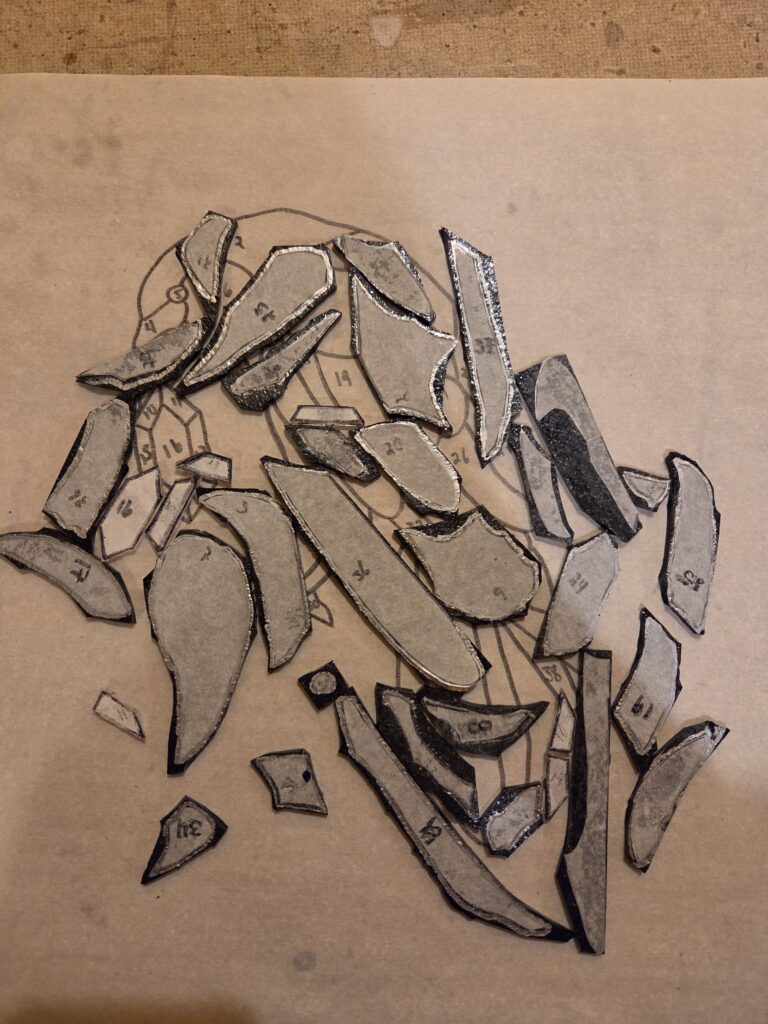
When I tried breaking the glass, everything got worse.
Instead of clean breaks, the glass fractured into jagged edges. Tiny pieces refused to come off with my grozing pliers, no matter how hard I squeezed. The few pieces that did break free exploded into microscopic shards that launched across my workspace and somehow embedded themselves into my fingertips.
As if that wasn’t enough, the glass itself was noticeably thicker than anything I had worked with before, making every cut even harder.
By the time I broke my third medium-difficulty piece, I was ready to throw in the towel.
I seriously considered scrapping the entire project.
I told myself I had simply chosen the wrong glass, learned an expensive lesson, and could move on to something easier.
Why I Didn’t Give Up on This Stained Glass Project
I took a breather and started reading posts in the Stained Glass Patterns Facebook group from other artists struggling with difficult glass and frustrating projects. The comments were filled with encouragement from people who had been creating stained glass for years. Some admitted they had projects sitting unfinished for months or even years because they became so frustrated. Eventually they came back, finished them, and the final pieces were absolutely beautiful.
I realized that I needed to finish the piece. I told myself it didn’t matter how hard it was or how crappy it turned out, I was going to finish it.
So I went back to the table, looked at my ever-growing pile of broken pieces that needed to be retraced and glued back onto the glass, looked at the mountain of tiny glass splinters scattered across my table, and accepted one simple fact.
I wasn’t going to out-cut this glass.
I was going to out-grind it.
Instead of trying to make perfect, intricate cuts, I began cutting many of the pieces as rough rectangles and intentionally left far more material than I normally would. I knew it meant hours behind the grinder, but that seemed far more realistic than trying to force precise breaks out of glass that clearly didn’t want to cooperate.
It worked… sort of.
By the time every piece finally fit together, I had spent roughly five hours grinding. Somewhere along the way I got a little overconfident and accidentally ground a couple pieces too small. They no longer fit the pattern very well, but by then my back hurt, my fingernails were chipped, and I had collected glass splinters in my fingers, hands, and thighs.
There was absolutely no chance I was recutting those pieces, so I decided this was going to become a lesson in solder patching instead.
Oh, and somewhere during the process I managed to lose one of the raven’s toes.
He’s officially a two-toed raven now.
The Finished Piece Wasn’t Pretty… But I Finished It
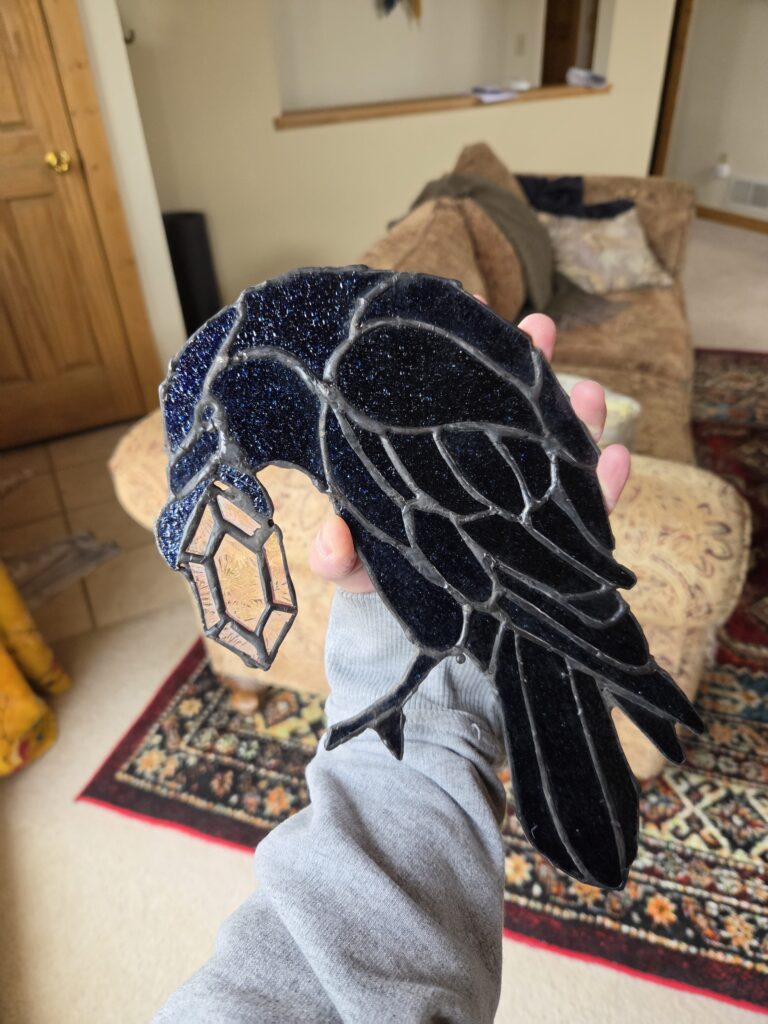
I was actually excited to solder this piece, but somehow the soldering turned out even worse than my very first piece, and the beaded edge even worse. My bead was inconsistent, my edge beading was downright awful, and by the end I had convinced myself I had forgotten everything I had learned over my first four pieces.
But I finished it.
Is it my prettiest stained glass piece?
Absolutely not.
It’s honestly pretty ugly.
The solder lines are clumpy, the fit isn’t great, and if you look closely you’ll definitely notice our poor two-toed raven. But it still sits on my fireplace mantel because from across the room, you don’t notice any of that. You just see a raven sneaking away with its shiny trinket.
And I’m focusing on all the lessons learned from it as well:
- Avoid solid glass as much as possible
- Make sure glass has a “smooth” side
- Glue sticks suck
- It’s okay to take a break and come back to it, even months later, and many artists do
- Don’t be afraid to leave extra material and let the grinder do more of the work when dealing with difficult glass.
I’ll never look at that raven and see a beautiful stained glass piece. Instead, I’ll always see the project that taught me perseverance.